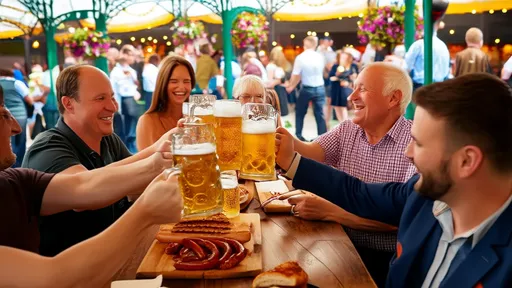
In the heart of Munich, where the clinking of beer steins echoes through historic halls, an unspoken tradition thrives—one that transcends language barriers and cultural divides. The act of sharing a table with strangers at Oktoberfest, or any Bavarian beer hall for that matter, is not merely a logistical solution to crowded venues. It is a microcosm of German Gemütlichkeit, a philosophy of warmth and communal joy that turns acquaintances into temporary kin over foamy liters of helles or dunkel.
Walk into the Hofbräuhaus on a lively evening, and you’ll witness this ritual unfold organically. Long wooden tables, scarred by decades of knife marks and spilled ale, stretch endlessly under vaulted ceilings. Patrons squeeze shoulder-to-shoulder, their laughter blending with oompah music. Here, the question "Ist hier noch frei?" (Is this seat taken?) is an invitation as much as a practicality. To decline would be unthinkable—a breach of beer-hall etiquette that prioritizes camaraderie over personal space.
The origins of this custom trace back to Bavaria’s agrarian past, when communal tables in village inns served as equalizers. Farmers, merchants, and nobles alike broke bread (and drank beer) side by side, their social hierarchies momentarily dissolved by shared pitchers. Modern iterations retain this democratic spirit. At Oktoberfest’s Schottenhamel tent, CEOs in lederhosen might toast with backpackers, while grandmothers teach wide-eyed tourists the art of Masskrugstemmen (stein-holding competitions). The table becomes a stage for cultural exchange, fueled by liquid courage and pretzel crumbs.
Yet the practice isn’t without its unspoken rules. Seasoned attendees know to avoid the cardinal sin of resting elbows on the table—a faux pas dating to medieval times when space was scarce. Eye contact during "Prost!" is mandatory; skipping it allegedly brings seven years of bad sex. And woe betide the visitor who tries to reserve seats with jackets or bags during peak hours. Such behavior invites glares sharper than a Bierkönig’s (beer king’s) hangover.
Anthropologists argue that beer-hall socialization offers a rare antidote to urban isolation. In an era of digital connections, the tactile experience of clinking glasses with strangers—of singing "Ein Prosit der Gemütlichkeit" arm-in-arm—creates fleeting but profound bonds. Psychologists note how alcohol’s inhibition-lowering effects merge with the safety of structured traditions, allowing even introverts to join the revelry. "It’s like speed-friending with a 1-liter minimum," quips a regular at Augustiner-Keller.
For locals, these encounters are second nature. A Munich native recalls childhood memories of sharing Obatzda (cheese spread) with tourists who didn’t know a brezn from a bretzel. "We’d end up exchanging addresses," she laughs. "Next thing, they’re visiting us for Christmas." Meanwhile, business deals are sealed between sips, startups brainstorm over radlers, and expats find their footing through impromptu table alliances.
Challenges persist, of course. Post-pandemic hesitations linger among some, while overtourism strains the authenticity of interactions. But the essence endures. As one brewer puts it: "A table without strangers is just furniture." So when you find yourself in a Bavarian beer hall, embrace the squeeze, raise your Mass, and remember—the person beside you might arrive as a stranger, but they’ll leave as part of the story.

By /Aug 13, 2025

By /Aug 13, 2025

By /Aug 13, 2025

By /Aug 13, 2025

By /Aug 13, 2025

By /Aug 13, 2025

By /Aug 13, 2025

By /Aug 13, 2025

By /Aug 13, 2025

By /Aug 13, 2025
By /Aug 13, 2025

By /Aug 13, 2025

By /Aug 13, 2025

By /Aug 13, 2025

By /Aug 13, 2025

By /Aug 13, 2025

By /Aug 13, 2025

By /Aug 13, 2025

By /Aug 13, 2025

By /Aug 13, 2025
