The intoxicating rhythms of flamenco have long held the power to stir the soul, a secret musical language passed down through generations of gypsy musicians in the sunbaked hills of Andalusia. Unlike any other art form, flamenco dances on the razor's edge between structure and chaos - its compás (rhythmic cycle) acting as both prison and playground for performers. To understand flamenco is to decipher its rhythmic DNA, where ancient Indian, Arabic, and Spanish musical traditions collide in a fiery explosion of cultural alchemy.
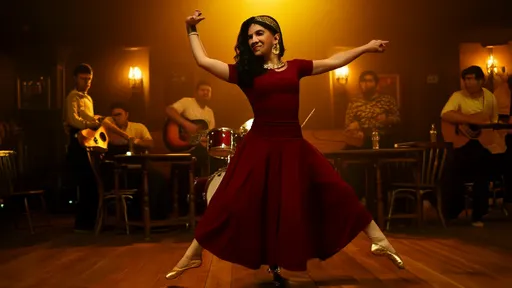
At the heart lies the palmas - the intricate handclapping patterns that serve as flamenco's heartbeat. What appears spontaneous to untrained ears follows mathematical precision, with different palos (styles) adhering to specific time signatures. The soleá moves in haunting 12-beat cycles, while bulerías accelerate in a dizzying 12/8 meter that seems to both defy and define gravity. Veteran cantaores (singers) speak of rhythms as living entities - the compás isn't merely counted but felt in the marrow, a truth revealed when watching elderly gypsy women mark complex rhythms with their knuckles on wooden tables.
The guitar's role transcends accompaniment in this musical ecosystem. A true tocaor doesn't merely follow the dancer but engages in a dangerous flirtation with time itself. Listen closely to the rasgueado strumming patterns during a seguiriya - the guitarist deliberately lingers milliseconds behind the beat, creating unbearable tension before crashing back into synchronization like waves meeting shore. This rhythmic elasticity, called aire, separates technical players from those who understand flamenco's visceral language.
Modern musicologists armed with digital metronomes have attempted to quantify these rhythms, often failing spectacularly. The magic lives in the imperfections - that fractional hesitation before a foot stomp (zapateado), the almost imperceptible acceleration during a dancer's turn. These "errors" contain centuries of oral tradition, what old masters call duende - the moment when technical skill surrenders to something more profound. Recording engineers in Seville speak of veteran artists refusing to record to click tracks, insisting the studio walls must "breathe" with them.
Contemporary flamenco innovators now deconstruct these ancient rhythms with jazz harmonies and electronic textures, yet the compás remains sacrosanct. Young dancers still spend years mastering the contratiempo (off-beat accents) of tangos, just as their great-grandparents did. In underground peñas (flamenco clubs) from Jerez to Barcelona, you'll find teenagers dissecting Diego del Gastor's rhythmic displacements with the same intensity as hip-hop producers sampling breakbeats - proof that flamenco's rhythmic cipher continues evolving while staying rooted in blood memory.
The true revelation comes when witnessing a juerga (flamenco jam) at dawn. As exhaustion lowers inhibitions, the rhythms grow wilder yet more precise - a paradox only flamenco can embody. Here, the mathematics dissolve into something primal, the compás becoming not a structure but a living pulse connecting participants across centuries. This is flamenco's ultimate secret: its rhythms don't reside in notation or theory, but in the spaces between heartbeats when artist and audience forget where the music ends and their bodies begin.
By /Aug 13, 2025
By /Aug 13, 2025
By /Aug 13, 2025
By /Aug 13, 2025
By /Aug 13, 2025
By /Aug 13, 2025
By /Aug 13, 2025
By /Aug 13, 2025
By /Aug 13, 2025
By /Aug 13, 2025

By /Aug 13, 2025
By /Aug 13, 2025
By /Aug 13, 2025

By /Aug 13, 2025

By /Aug 13, 2025
By /Aug 13, 2025
By /Aug 13, 2025
By /Aug 13, 2025
By /Aug 13, 2025
By /Aug 13, 2025
